 |
||||||
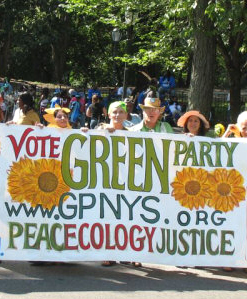 |
About the Green PartyThe Green Party has its origins in the environmental, civil rights, anti-war, anti-nuclear and feminist movements of the 1960s and 1970s. The first Green parties formed in Tasmania and New Zealand in 1972. Today there are Green parties and political movements in over 90 countries. Green parties have elected representatives in all corners of the world at local, state and national levels, and in the European Parliament. For information about the Global Greens Network, visit http://www.globalgreens.org/ The Green Party began in the United States in 1984 with the formation of the Green Committees of Correspondence. The Ten Key Values were adopted at this time. In 1990, the Green Party of Alaska became the first green party in the U.S. to achieve ballot status. Today, the Green Party has ballot status in 26 states and expects its 2020 presidential candidates to be on the ballot is 45 states. In 1986, only one green candidate stood for election in the United States. As of April 2020, 129 Greens hold elected office in the US. For more information about the Green Party US visit http://www.gp.org/ One of the best ways to understand the Green Party is to read our platforms. The Green Party of New YorkThe Green Party of New York retained ballot status in the 2018 general election. GPNY first obtained ballot status in 1998 after organizing in this state since the late 1980s. We lost ballot status in 2002, but won a federal court order in 2005 directing the Board of Elections to continue allowing New Yorkers to enroll in the Green Party or in any other party that successfully places a candidate on the ballot in the previous gubernatorial election. GPNY qualified again in 2010 and re-qualified in the 2014 general election. Under the New York Election Law, political parties gain or lose ballot status depending upon how many votes their gubernatorial candidate receives. New York has one of the most restrictive ballot access laws in the country, due to the fact that ballot status hinges entirely upon one race every four years. In many states, any statewide candidate or presidential candidate can qualify a party for ballot status. In New York, only the gubernatorial race qualifies. The Green Party of New York and the Libertarian Party of New York filed a Federal lawsuit on July 27, 2020 in the Southern District of New York to invalidate restrictive ballot access provisions passed as a rider to the FY2021 New York State Budget. Read the GPNY press release. The Steuben County Green PartyThe Steuben County Green Party formed in 2002. We work on Green issues and run candidates in local, state and federal elections. Four members of the Steuben Greens have run for public office. Most recently Elizabeth Whitehouse was the Green Party candidate for Mayor of the City of Corning in 2019 and Jamie Cooney was the candidate for Corning Town Council. Jamie was appointed to the Village of South Corning Board of Trustees in 2020. Click here for the list of our current officers and their contact information.
|
|
|
Home | About the Green Party | Calendar | Email: info at steubengreens.org
|